
By Carbon Fusion
Many people who want to start recycling plastic assume they need a full factory line. Most do not. A small unit can start with a handful of machines, as long as they fit the product you plan to make.
Quick answer: A small plastic recycling unit really needs three things: a shredder, one machine that turns flakes into a product (an injection machine, extruder or sheet press), and a basic space for sorting, washing and drying. To keep costs low, start with one product, choose entry-level or combo machines, and compare total cost rather than machine price alone. Carbon Fusion’s listings range from a hand-cranked shredder that needs no electricity to combo units that bundle machines together.
What you’ll learn in this article:
- What a small recycling unit is and why starting small works
- The four core machines, and which one to buy first
- What else a unit needs besides machines
- A five-step way to keep costs low
- Three example starter setups, common mistakes and FAQs
Contents: What it is | Why start small | Core machines | What else you need | Keeping costs low | Starter setups | Mistakes and FAQs | Conclusion
Not sure which machine to start with? Talk to the Carbon Fusion team about your plastic, product idea and budget.
What Is a Small Plastic Recycling Unit?
A small plastic recycling unit is a compact workshop that collects plastic waste, shreds it and turns it into new products, using a few machines instead of a large industrial line. Typical owners are startups, schools, community groups, designers and small manufacturers. For the wider process, see this overview of plastic recycling.
Why Starting Small Makes Sense
- Lower risk: you learn your plastic supply and your customers before committing to bigger machines.
- Faster start: compact machines need less space, power and installation.
- Room to grow: a good shredder keeps its value when you add an extruder or press later.
- Real product testing: you can try small batches and see what sells.
The Four Core Machines in a Small Unit
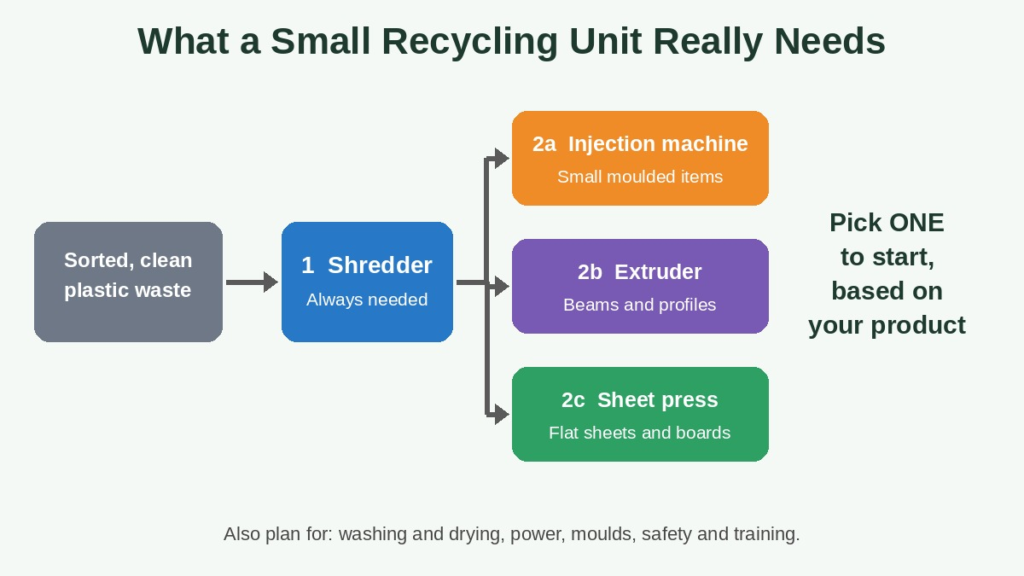
You rarely need all four at the start. Pick the ones that match your product.
| Machine | What it does | Good first products | Carbon Fusion entry options |
|---|---|---|---|
| Shredder | Cuts plastic waste into small flakes | Needed by every other machine | Manual shredder, tabletop shredder |
| Injection machine | Melts flakes and injects them into a mould | Small moulded items | Manual injection machine |
| Extruder | Melts flakes and pushes them out as a shape or into a mould | Beams, profiles, larger moulded parts | Mini extrusion, Extruder Version 3 |
| Sheet press | Presses flakes into flat sheets | Boards and panels for furniture and crafts | Combo unit with a shredder, see below |
Shredder: The Non-Negotiable
Almost every route starts here. Carbon Fusion lists a dual-axis manual shredder as a low-cost way to begin that needs no electricity, which suits training, demonstrations and areas with limited power. For regular volume, step up to the tabletop or V3 shredder. The V3 is listed with a 2 HP single motor and a 1:30 gearbox.
Injection Machine: Small Products
An injection machine fills a mould with melted plastic, which suits small, repeatable items. Carbon Fusion’s listings include an injection machine with a free pot mould. Read more about the process in this overview of injection moulding.
Extruder: Beams and Profiles
An extruder suits longer shapes. The V3 is listed with a 2 HP single-phase motor and about 8 to 12 kg per hour depending on configuration. For a full comparison, read our guide to choosing a plastic extrusion machine.
Sheet Press: Flat Boards
A sheet press turns flakes into flat sheets you can cut and shape. A bench-size combo is a sensible start. See the sheet press, shredder and injection combo unit.
What Else a Small Recycling Unit Needs
- Sorting and washing area: clean, sorted plastic gives better products.
- Drying space: wet flakes cause defects when melted.
- Power: many entry machines run on single phase 220 to 240 V. Check your supply first.
- Moulds: your product depends on them, so budget for moulds as well as machines.
- Safety basics: look for overload protection and emergency stops.
- Training and support: Carbon Fusion’s listings mention virtual sessions, technical support and installation help.
How to Keep Costs Low in 5 Steps
Step 1: Choose One Product First
Decide what you will make: small moulded items, beams or flat sheets. The product decides the machine.
Step 2: Match One Machine to That Product
Buy the shredder plus the single machine that makes your product. Add others only when orders justify them.
Step 3: Consider a Combo Unit
Combo units such as the sheet press and extrusion combo bundle machines, which can simplify buying and shipping.
Step 4: Start Manual or Tabletop If Volume Is Small
If you process only a few kilograms at a time, a manual or tabletop shredder avoids paying for capacity you will not use.
Step 5: Compare Total Cost, Not Machine Price
Total cost = machines + moulds + installation and training + power and space + labour. A cheaper machine without moulds or training can cost more overall.
Three Example Starter Setups
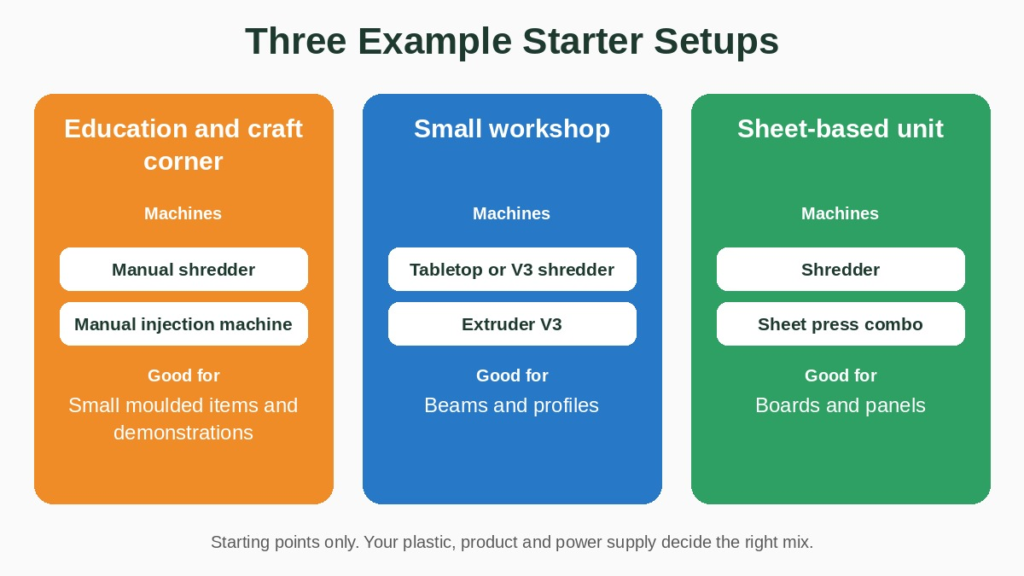
- Education and craft corner: manual shredder plus manual injection machine for small moulded items and demonstrations.
- Small workshop: tabletop or V3 shredder plus the extruder V3 for beams and profiles.
- Sheet-based unit: a shredder and sheet press combo for boards and panels. Browse the Carbon Fusion machine range to compare options.
These are starting points, not recommendations for every business. Your plastic, product and power supply decide the right mix.
Common Mistakes When Buying Low-Cost Machines
- Buying every machine at once. Start with the shredder and one product machine.
- Ignoring moulds. Moulds shape your product and need their own budget.
- Skipping the power check. Confirm voltage and phase before ordering.
- Choosing on price alone. Check capacity, safety features and support.
- Using dirty or mixed plastic. Sort and wash first for better results.
Frequently Asked Questions
What is the cheapest way to start plastic recycling?
A manual shredder plus a small moulding machine is a common low-cost start. Carbon Fusion lists a hand-cranked shredder that needs no electricity.
Do I need all four machines?
No. You need a shredder and one machine that suits your product. Add more later.
Can I run these machines on normal power?
Many entry-level machines are listed for single phase 220 to 240 V. Check each specification before ordering.
Which plastics can small machines handle?
Listed Carbon Fusion machines work with HDPE, LDPE, PP and PS, with some listings adding other plastics. Check the specification for your material.
How do I get a price for a small setup?
Request a quote with your plastic type, product idea and daily volume.
Conclusion: Start Small, Match the Machine to the Product
A small recycling unit succeeds when it starts with one product and the machines that make it, then grows with orders. Compare total cost, plan for moulds and training, and keep your setup simple.
Ready to plan your unit? Explore the machine range, read about Carbon Fusion, or request a quote.
