
By Carbon Fusion

A dark park path feels unsafe, and a rusty lamp post looks neglected. Lighting that is weatherproof, decorative and made from waste solves both problems at once.
Quick answer: Recycled plastic garden lamps are outdoor light fittings whose body is made from post-consumer plastic instead of metal, wood or concrete. They do not rust or rot, need little upkeep and suit parks, campuses, pathways and townships. Carbon Fusion’s recycled plastic park lamp uses about 5 kg of recycled plastic per lamp, with a CNC-cut pattern, a metal frame and LED lighting.
What you’ll learn in this article:
- What recycled plastic garden lamps are and how they are built
- Why eco lighting matters for public spaces in India
- Where these lamps work best
- How to plan and install them, step by step
- How to choose, maintain and avoid common mistakes
Contents: What they are | Why they matter | Where they work | How to plan and install | How to choose | Care | Common mistakes | FAQs
Lighting a park, campus or township? Ask Carbon Fusion about bulk supply or browse our recycled plastic public amenities.
What Are Recycled Plastic Garden Lamps?
Recycled plastic garden lamps are low-height outdoor lights, such as bollards, lanterns and path lights, whose outer body is made from reused plastic. A light source, usually LED, sits inside, and a frame or base holds the lamp steady on the ground or on a pole.
A typical lamp has three parts:
- The body: recycled plastic panels, often cut with a decorative pattern so light spills out softly.
- The frame: a metal or rigid frame that keeps the body square and anchors it to the ground or a pole.
- The light source: an LED fitting, wired to the site supply.
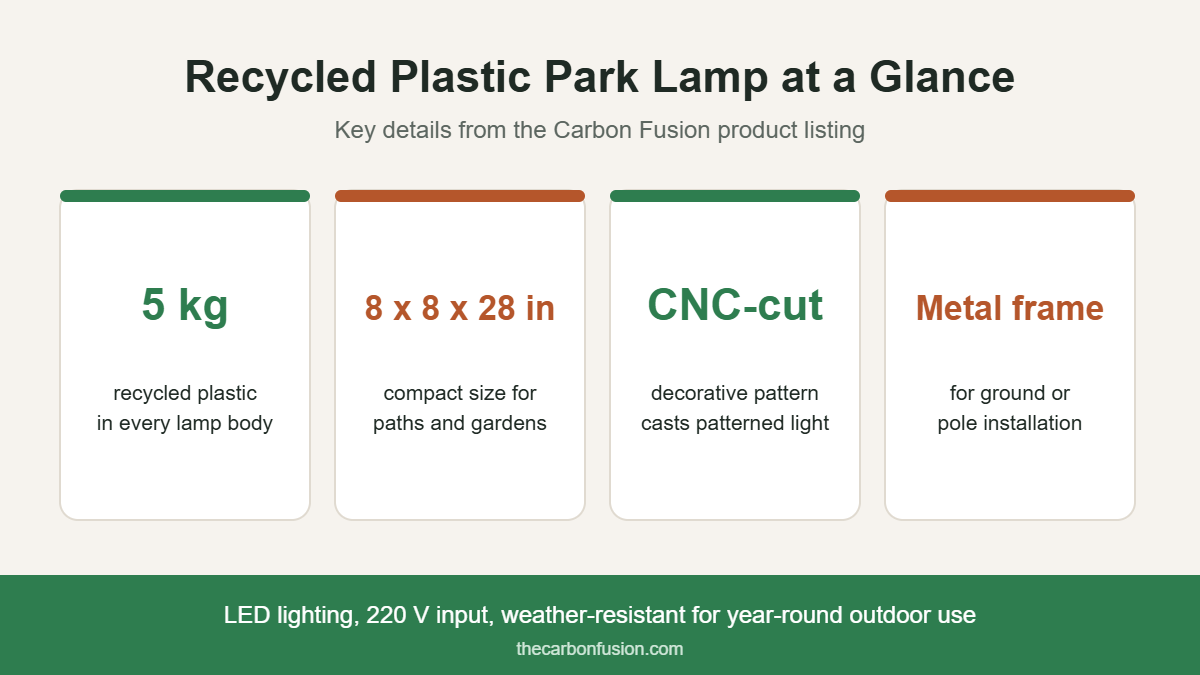
Carbon Fusion’s lamp, for example, measures 8 x 8 x 28 inches, has a CNC-cut decorative pattern and a metallic frame for ground or pole installation. Panels like these start as recycled plastic sheets, the kind made on a plastic sheet press.
Why Eco Lighting Matters for Public Spaces
India has already moved public lighting toward efficiency. The government’s Street Lighting National Programme was launched on 5 January 2015 to replace conventional street lights with LEDs, and EESL had installed over 1.23 crore LED street lights by March 2022.
The next step is the fitting itself. India generated 4,126,997 tonnes of plastic waste in 2020-21, according to CPCB figures shared by the Ministry of Environment (PIB). A lamp body made from that waste keeps plastic in use for years instead of in a landfill.
Benefits for buyers:
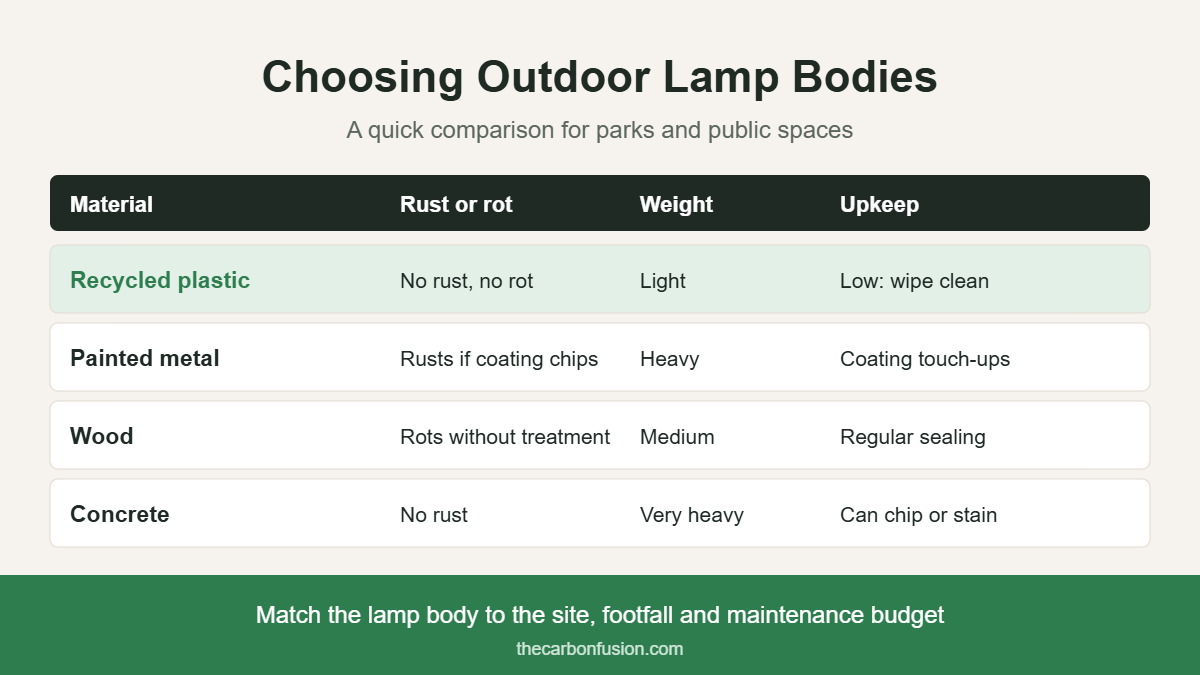
- No rust or rot. Plastic stands up to rain, humidity and garden sprinklers better than bare metal or untreated wood.
- Low upkeep. No repainting or sealing; a wipe-down keeps it clean.
- Decorative light. CNC-cut patterns cast soft shapes on paths and lawns.
- A visible green message. Residents and visitors can see the waste-to-value idea in daily use.
- Lighter to handle. Easier to transport and install than concrete or cast metal bollards.
Where Recycled Plastic Garden Lamps Work Best
Parks and Public Gardens
Line walking tracks and lawn edges, and pair the lamps with recycled plastic benches and seating for a consistent look.
Housing Societies and Townships
Pathways, podium gardens and clubhouse lawns need safe, low-glare lighting that residents won’t have to repaint every year.
Campuses, Schools and Offices
Lamps along walkways and courtyards support green-campus goals and look good in brochures and visits.
Resorts, Cafés and Farmhouses
Patterned light creates atmosphere for evening dining and garden events.
Smart City and Municipal Projects
Bulk orders can match other recycled public amenities, such as an e-waste collection bin, so a whole public space carries one sustainable design language.
Need lamps in bulk? Share your site plan and quantity with Carbon Fusion. The product page notes that custom designs and heights are available.
How to Plan and Install Recycled Plastic Garden Lamps: Step by Step
Every site is different, but most projects follow these steps.
Step 1: Map the Area
Walk the site in the evening. Mark dark spots, path junctions, steps and seating areas that need light first.
Step 2: Decide the Spacing
Plan even pools of light along paths rather than a few bright spots. Your electrician or lighting consultant can set spacing based on the LED fitting and path width.
Step 3: Plan Power and Cabling
Agree cable routes, junction boxes and switching or timers before landscaping is finished, so you don’t have to dig twice.
Step 4: Choose Ground or Pole Mounting
Ground-mounted lamps suit lawns and path edges; pole mounting raises the light for wider areas. Carbon Fusion’s lamp frame supports either.
Step 5: Install and Anchor
Fix each frame firmly to a base so lamps cannot be knocked over or pulled out. A licensed electrician should handle all wiring.
Step 6: Test at Night
Switch on after dark, walk the route again and adjust any lamp that leaves gaps or causes glare.

How to Choose Recycled Plastic Garden Lamps
| Question to ask | Why it matters |
|---|---|
| How much recycled plastic is in it? | A stated figure, such as 5 kg per lamp, shows real waste diversion. |
| What size and height? | Low lamps suit paths and flower beds; taller or pole-mounted units light wider areas. |
| How is it mounted? | A metal frame or base keeps the lamp stable on ground or pole. |
| What light source and voltage? | Check the LED fitting and input voltage match your site wiring. |
| Can it be customised? | Projects often need matching heights, patterns or colours across a site. |
| Is bulk supply possible? | Parks and townships need consistent stock and delivery. |
Planning furniture too? See the benefits of recycled plastic garden furniture for homes, resorts and parks.
How to Care for Recycled Plastic Garden Lamps
- Wipe the body with water and mild soap every few months to clear dust and insects.
- Check the frame and fixings once a year and after storms.
- Inspect cables and connections through your electrician as part of routine maintenance.
- Replace the LED fitting when it dims, rather than the whole lamp.
- Avoid harsh solvents that can mark the plastic.
Common Mistakes to Avoid
- Lighting too brightly. Glare makes paths feel less safe, not more.
- Skipping the anchor. Loose lamps get knocked over or taken.
- Ignoring cable planning. Retrofitting wiring after landscaping costs more.
- Mixing styles at random. Matching lamps, benches and bins look more planned.
- Ordering without a sample. See one lamp lit at night before a bulk order.
Frequently Asked Questions
What are recycled plastic garden lamps made of?
The body is made from recycled, post-consumer plastic, usually as cut panels. A metal frame holds it in shape and an LED fitting provides the light.
Are recycled plastic lamps weatherproof?
They are built for outdoor use. Plastic does not rust or rot, and Carbon Fusion lists its lamp as weather-resistant for year-round outdoor use. Wiring and fixings still need proper installation.
How much recycled plastic goes into one lamp?
Carbon Fusion’s park lamp uses about 5 kg of recycled plastic per lamp, according to its product listing.
Can the lamp be mounted on a pole?
Yes. The metal frame supports ground or pole installation, so it can suit both path edges and wider open areas.
Can I order custom designs or bulk quantities?
Yes. Carbon Fusion offers custom designs and heights and bulk supply for parks, campuses and townships. Contact the team with your quantities and site details.
Conclusion: Light Public Spaces With Less Waste
Recycled plastic garden lamps combine safe, decorative lighting with a material that does not rust or rot. Plan the layout and wiring carefully, anchor every lamp and keep up simple cleaning, and they will light paths and parks for years while keeping plastic out of landfill.
Ready to light your space? View the recycled plastic park lamp, read about Carbon Fusion, or request bulk pricing and custom options.
